

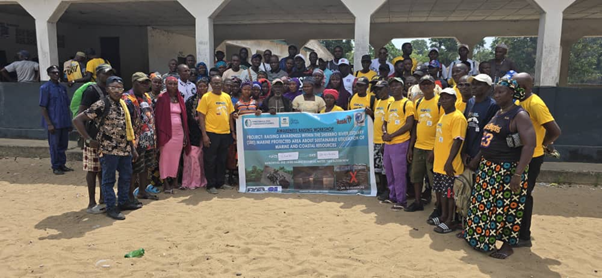
Over 80 participants, including councillors, chairladies, headmen, harbour masters, fishermen, fishmongers, sea turtle monitors, and other key stakeholders from Turtle Island and Sherbro Island communities in Deima Chiefdom, Bonthe District, have commended the Reptile and Amphibian Program Sierra Leone for its impact in the area, particularly in education and awareness creation. They pledged their continued support for the project.
Among others, the Paramount Chief, the Speaker, and other stakeholders revealed that all four sections in the chiefdom now have two schools each, noting that they are experiencing more benefits now than when sea turtles were previously hunted.
The Paramount Chief of Deima Chiefdom, P.C. Anshun Ngabay IV, commended RAP-SL for bringing enlightenment and education to the chiefdom by sensitizing communities on the importance of mangroves, turtles, manatees, and other marine species, as well as empowering local people. He praised residents for adhering to laws prohibiting the killing of sea turtles and the destruction of mangroves.
The remarks were made on Thursday, 30th April 2026, at the Deima Chiefdom Administration Community Barri in Chepu during a sensitization meeting organized by RAP-SL on the protection of sea turtles, manatees, reptiles, and mangroves.
The Paramount Chief noted that while mangrove cutting occurs in some areas, locals in Turtle Island mainly purchase firewood for fish processing. He said he is collaborating with neighbouring chiefdoms to enforce environmental laws protecting mangroves, sea turtles, and other species.
He reminded residents that the local fine for killing a turtle in Deima Chiefdom is Le500, warning that offenders will face the full force of the law.
However, he raised concerns about the need for improved energy-efficient ovens. He noted that although RAP-SL, through Mr. Eddie and donor support, has provided over 150 improved ovens, they remain insufficient. He appealed for more support, stressing that compliance with conservation laws requires adequate alternatives for livelihoods.
The Paramount Chief also commended RAP-SL for its support and emphasized the importance of healthy competition among NGOs, stating that collaboration is key to sustainable development.
He further condemned proposed zircon mining in the chiefdom, stating that although five investors have shown interest, mining such minerals could endanger the island. He encouraged residents to report any activities that undermine development.
The Founder and Managing Director of RAP-SL, Mr. Edward Aruna, stated that the organization remains committed to the protection and conservation of sea turtles, manatees, mangroves, and other endangered species in Sierra Leone.
He highlighted an award he received from His Royal Highness, Prince William, Prince of Wales, in recognition of his conservation work under Tusk. He also noted support from partners including PRCM for sea turtles and mangroves, and RAMPAO for sustainable coastal resource management.
Mr. Aruna called on all Sierra Leoneans to prioritize the protection of natural resources, stressing that climate change is a real and ongoing threat, particularly in coastal communities such as Turtle Island, where land loss is increasingly evident.
He explained that climate change is also affecting sea turtle populations, resulting in a higher number of female turtles due to rising sand temperatures on nesting beaches. He noted that temperatures between 27–28°C produce a balanced sex ratio, while higher temperatures result in predominantly female hatchlings.
He further explained that male turtles have long tails used during mating, while females have shorter tails and come ashore to lay eggs.
On manatees, he stated that RAP-SL has recorded their presence in both Bonthe and Moyamba Districts, though they face similar threats and require protection under national law.
He also emphasized the importance of mangroves, describing them as vital coastal ecosystems that support marine biodiversity and contribute significantly to carbon sequestration. He explained that mangroves are salt-tolerant plants that filter most of the salt they absorb and can also grow in freshwater environments.
Mr. Aruna added that RAP-SL is conducting ongoing mangrove research in collaboration with the University of Manchester, Njala University, and other institutions in Europe across Sierra Leone, Guinea, and Liberia.
He clarified that while some organizations are focusing on mangroves for carbon credit, RAP-SL is currently focused on conservation rather than carbon trading.
He appealed for stronger community efforts to manage natural resources sustainably, noting that environmental issues such as climate change have no borders.
During the experience-sharing session, participants noted that Sierra Leone has vast mangrove ecosystems with significant potential for blue carbon initiatives, provided there is increased awareness and conservation.
On improved ovens, participants highlighted high demand for more efficient and affordable alternatives. A fishmonger revealed that firewood costs have significantly reduced from Le2,000 to about Le400, with some now using coconut shells for fish drying.
Mr. Aruna disclosed that new durable wire mesh ovens (8ft x 4ft) will replace older models, and assessments will be conducted to identify new beneficiary communities.
The event concluded with a lively question-and-answer session and the distribution of T-shirts.