

By Lemuella Tarawallie
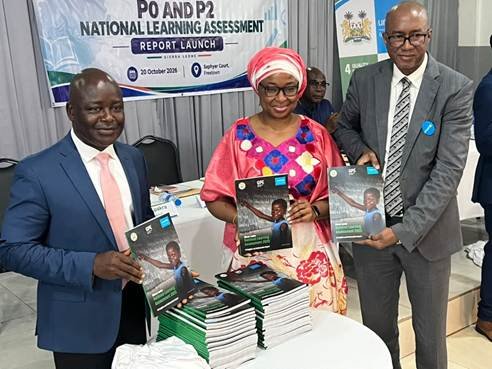
The Ministry of Basic and Senior Secondary Education (MBSSE), with support from the United Nations Children’s Fund (UNICEF), has launched the 2025 and 2026 Primary 0 (P0) and Primary 2 (P2) National Learning Assessment Reports to strengthen foundational literacy and numeracy, identify learning gaps and guide evidence-based education planning across Sierra Leone’s 16 districts.
The reports provide evidence on children’s school readiness and their acquisition of foundational learning skills, helping the government identify learning gaps and direct educational resources where they are most needed.
Speaking at the official launch of the National Learning Assessment Reports on Tuesday, 20 October 2026, Minister of Basic and Senior Secondary Education Conrad Sackey said the assessments were designed to determine whether children were learning, rather than simply attending school.
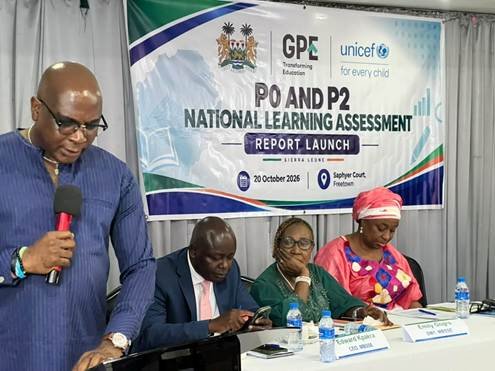
“A gate is not a classroom, and a classroom is not an education,” Sackey said, stressing that school enrolment alone could not guarantee educational achievement.
He explained that the P0 assessment examines children’s readiness for primary education, while the P2 assessment measures the foundational skills they acquire by the end of Primary 2.
Minister Sackey said the findings would inform teacher training, the provision of teaching materials and the development of education policies. He disclosed that the ministry had trained 8,037 teachers and pledged to protect 60 minutes each for reading and numeracy daily for learners from P0 to P2.
He noted that the findings revealed persistent challenges in literacy, while learners appeared to perform better in mathematics. He linked these findings to the need for improved teaching approaches, greater use of local languages and targeted support for struggling learners.
The minister also emphasised the importance of using local languages to support early learning, alongside improved data collection and targeted interventions in districts with significant learning gaps.
He maintained that the government’s ambition was to ensure that, by 2030, every child in Sierra Leone could read at the expected level by the age of eight.
UNICEF Deputy Representative for Operations Alpha Cisse said the assessments established a baseline against which future progress could be measured.
He added that the true value of the assessments lay in how their findings were used to strengthen policies, improve teaching and learning, target resources effectively and ensure that every child could reach their full potential.
Cisse said UNICEF was proud to support the government-led initiative, with assistance from the Global Partnership for Education. He emphasised that evidence must translate into better teaching and learning.
“Evidence alone does not change children’s lives. Action does,” he noted.
Cisse also highlighted the importance of tracking progress towards Sustainable Development Goal Four, which focuses on inclusive and equitable quality education.
Chief Education Officer Edward Kpakra said the reports represented an important opportunity to understand children’s learning needs and strengthen education delivery.
He noted that the assessments should not be used to blame teachers, school leaders, parents or learners, but rather to identify weaknesses and develop practical solutions.
“Assessment must not end with the identification of a problem. It must lead to action that produces improvement,” Kpakra said, urging stakeholders to use the findings to improve classroom practices, teacher development and learning outcomes.
Meanwhile, Dr Albert C. T. Duppigny said the launch should lead to concrete commitments rather than leave the reports unused.
He called on participating institutions and individuals to develop practical recommendations and address inequalities in foundational learning, including geographical and gender disparities.