

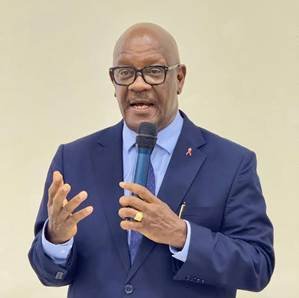
Health Minister Dr. Austin Demby
By Mo Hamad Kargbo
Sierra Leone’s health expenditure has increased in nominal terms since 2020 but declined significantly in real terms, raising concerns about the country’s ability to sustain essential health services and make progress towards Universal Health Coverage (UHC), according to UNICEF Sierra Leone’s Health Budget Brief 2026.
The report states that the government allocated SLE1.38 billion to the health sector in 2026, nearly double the SLE706 million allocated in 2020. However, after adjusting for inflation, the 2026 allocation is estimated at only SLE656.9 million, indicating a significant loss in the purchasing power of health spending over the period.
The 2026 health allocation also represents a 7 per cent decline compared with 2025. UNICEF warned that the reduction could place additional pressure on the health sector’s ability to maintain and expand essential services, particularly primary healthcare (PHC), child health and efforts towards UHC.
The report further found that health spending accounted for only 4.6 per cent of the national budget in 2026, considerably below the 15 per cent target under the Abuja Declaration. Health expenditure also remained below 1 per cent of gross domestic product (GDP), falling short of Sierra Leone’s national target of 5 per cent of GDP by 2030, endorsed through the National Health Compact at the UHC Forum in December 2025.
UNICEF noted that both indicators have largely stagnated since 2021, with a slight decline between 2025 and 2026. The report said this reflects limited prioritisation of health within public expenditure and highlights the need for sustained additional investment.
The Budget Brief also highlighted persistent challenges in child survival, despite improvements in mortality rates.
The under-five mortality rate declined from 137 deaths per 1,000 live births in 2015 to 90 in 2024. Although Sierra Leone’s rate is slightly below the West and Central Africa average of 91, it remains above the sub-Saharan Africa average of 71.
The report stated that the country remains off track to achieve the 2030 Sustainable Development Goal targets for under-five, neonatal and maternal mortality at the current pace of improvement.
In 2023, the number of child deaths was estimated at just over 31,000, down from more than 41,000 in 2015. Children under five accounted for nearly 24,000 of the deaths recorded in 2023.
Malaria remained the leading cause of death among children under five, accounting for approximately 24 per cent of under-five deaths in 2021. Other major causes included lower respiratory infections, prematurity, diarrhoea, and birth asphyxia or trauma.
UNICEF said these figures highlight the continued importance of prevention, timely treatment and stronger primary healthcare services.
The brief also recorded an increase in the number of health workers on the government payroll.
According to the report, the number of health workers increased by more than 50 per cent, from 12,515 in 2020 to 19,619 in 2026. Health worker density also rose from 15.8 to 21.8 health workers per 10,000 people during the same period.
Despite this improvement, UNICEF said staffing levels remain insufficient to meet the needs of the country’s population and the requirements for achieving UHC.
In 2025, Sierra Leone had 9,872 physicians, midwives and nurses, equivalent to approximately 11.2 skilled health workers per 10,000 people. This is significantly below the World Health Organization benchmark of 44.5 skilled health workers per 10,000 people considered necessary to support UHC and the Sustainable Development Goals.
The report further found that Sierra Leone’s health workforce remains heavily concentrated in nursing. Nursing professionals accounted for 57.1 per cent of health workers in 2025, followed by medical and healthcare assistants at 14.8 per cent and community health workers at 7.3 per cent.
Generalist medical practitioners represented only 3.6 per cent of the workforce, while pharmacists accounted for 2.3 per cent.
UNICEF said the composition of the workforce reflects a reliance on mid-level and support cadres, which could constrain access to advanced and specialised healthcare services.
The Budget Brief examines the adequacy, equity, efficiency, credibility and sustainability of public health spending between 2020 and 2026, with particular attention to children, primary healthcare and progress towards UHC.
The report also identified inconsistencies between Budget Speech Annexes, Annual Public Accounts and development assistance data, highlighting the need for stronger reconciliation and greater transparency in health financing reports.
UNICEF said improving the efficiency, sustainability and impact of health financing would require stronger government action and continued engagement among development partners, civil society organisations and other stakeholders.
The report concludes that increased and sustained investment in health, alongside improved spending efficiency and transparency, will be critical for Sierra Leone to strengthen primary healthcare, improve child survival and move closer to achieving Universal Health Coverage by 2030.