

By Mariama Bundu
Statistics Sierra Leone, in collaboration with the United Nations Population Fund (UNFPA) and other development partners, has launched a 50-day countdown to the December 2, 2026 Population and Housing Census, urging citizens and stakeholders to support the national exercise.
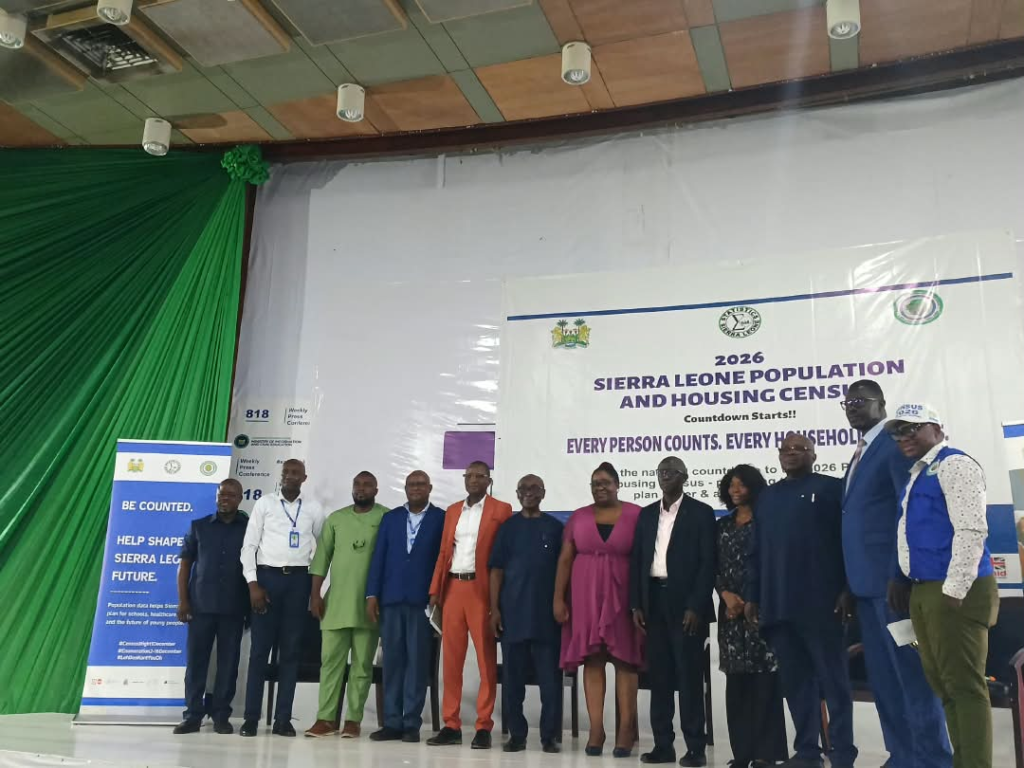
The countdown was launched on Monday, October 12, at the Miatta Civic Centre in Freetown during a high-level press briefing attended by government officials, development partners, political party representatives and members of the media.
The census will use December 1 as Census Night and is expected to provide vital population and housing data to guide national development planning and resource allocation.
In his remarks, Statistician General Andrew Bob Jonny said the national cartographic mapping exercise, pilot census and mock census had been completed, with preparations now focusing on finalising materials, preparing equipment, training personnel and increasing public awareness.
He assured the public that information collected would remain confidential and be used for statistical purposes, urging households to provide accurate information and cooperate with authorised enumerators.
UNFPA Deputy Country Representative Sibeso Mululuma commended the government for its commitment to conducting a credible, inclusive and fully digital census. She highlighted the arrival of 25,000 electronic tablets for census operations and reaffirmed UNFPA’s technical and financial support.
Mululuma identified data quality, inclusion and public trust as critical to the success of the exercise, calling on the media to promote accurate information, counter misinformation and encourage participation across all communities.
The Chairman of the Statistics Council also stressed the importance of involving political parties, paramount chiefs and other stakeholders to strengthen public confidence in the census.
Delivering the keynote address, Minister of Planning and Economic Development Kenyeh Barlay said reliable population and housing data were essential for determining the needs of communities and guiding decisions on education, healthcare, water supply, roads, employment and other public services.
She urged ministries, local councils, community leaders and citizens to support the exercise, emphasising that every individual and household must be counted, including those in remote communities and persons with disabilities.
The 2026 census is expected to provide government with the information needed to identify population trends, address gaps in service delivery and improve the planning and implementation of national development programmes.