

By Lemuella Tarawallie
UNICEF and UNFPA engaged journalists from across Sierra Leone as part of renewed efforts under the Global Programme to End Child Marriage, a flagship initiative aimed at protecting the rights and future of adolescent girls.
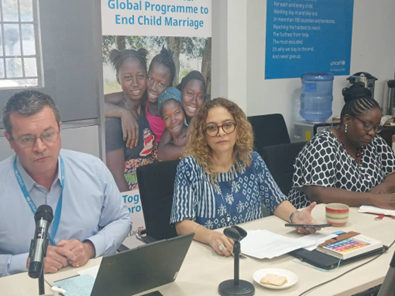
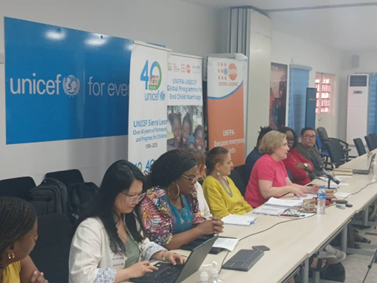
The engagement, held on Thursday 18 April 2026 at UNICEF’s Country Office, brought together media practitioners and members of the Global Programme Steering Committee following a joint field visit to assess progress and challenges in tackling child marriage in the country.
Speaking during the session, the Chief of Child Protection at UNICEF, Patrick Hollow, outlined the background of the programme, which was launched in 2016 as a joint initiative of UNICEF and UNFPA. He described it as a girl-centred, evidence-based intervention supporting countries with high rates of child marriage to implement sustainable solutions.
“The programme works across sectors, including child protection, education, health, and social protection, to ensure that girls remain in school, stay healthy, and are empowered to make informed life choices,” he said.
He emphasized that child marriage remains a violation of children’s rights, with far-reaching consequences for education, health, and economic opportunities. In Sierra Leone, about 30 percent of women aged 20 to 24 were married before the age of 18, highlighting the urgency of sustained action.
Despite the challenges, Hollow noted that Sierra Leone has made significant progress, particularly with the passage of the Prohibition Against Child Marriage Act in 2024, alongside other legal frameworks such as the Child Rights Act, the Sexual Offences Act, and the Gender Equality and Women’s Empowerment Act.
Members of the Steering Committee shared observations from their visit, pointing to notable improvements as well as areas requiring further attention.
Isabella Solou Helal, Chief Director of Gender-Based Violence on Child Protection at Global Affairs Canada, said Sierra Leone’s progress is evident, with child marriage rates dropping significantly over the years. She cited figures indicating a reduction from 48 percent in 2008 to about 30 percent in recent years.
“There is clear commitment from the government, reflected in legislative reforms and policies that promote girls’ education and protection. However, much work still remains,” she noted.
She further highlighted the role of communities, noting that traditional and religious leaders are increasingly supporting efforts to delay marriage and promote education for girls. Visits to Kambia and Koinadugu districts revealed strong community resilience and growing awareness of the dangers of child marriage.
Also speaking, Suzanne Wooster, UNICEF’s Chief of Communication, Advocacy and Partnerships, praised the determination of adolescent girls in Sierra Leone.
“The resilience, courage, and leadership shown by girls across communities is inspiring. They are not just beneficiaries of change; they are leading it,” she said.
UNFPA Deputy Representative Sibeso Mululuma emphasized practical interventions that are yielding results at the community level. These include safe spaces for girls, positive parenting initiatives, community dialogue platforms, and programmes that engage men and boys as partners in change.
She stressed that child marriage is not inevitable and can be prevented through collective action.
“It is our responsibility to ensure that every girl has the opportunity to reach her full potential. When we fail to act, the consequences affect not only individuals but entire communities and national development,” she said.
Mululuma called on the media to play a critical role in the fight against child marriage by amplifying the voices of girls, promoting accurate information, and shaping public discourse around harmful practices and legal reforms.
The engagement forms part of broader efforts by the Global Programme to accelerate progress as the 2030 target to eliminate child marriage approaches. Stakeholders reaffirmed their commitment to sustained investment, stronger partnerships, and community-driven solutions.
As Sierra Leone continues to record progress, the message from partners remains clear: ending child marriage requires united action, and the media has a powerful role to play in driving that change