

By Lemuella Tarawallie
UNICEF Sierra Leone, in collaboration with the Ministry of Finance and the Ministry of Basic and Senior Secondary Education, on Thursday, 23rd June 2026, launched a two-day Strategic Workshop on Blended and Innovative Financing for Education aimed at identifying sustainable funding mechanisms for the country’s education sector amid growing fiscal constraints and declining development assistance.
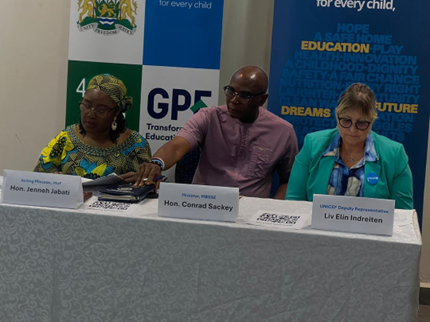
During the opening session at the New Brookfields Hotel in Freetown, UNICEF Sierra Leone Deputy Country Representative, Liv Elin Indreiten, said education systems globally are under increasing pressure due to a learning crisis, shrinking development assistance, and climate-related shocks.
“It is a great honour for UNICEF to join the Government of Sierra Leone in opening this strategic workshop on blended and innovative financing for education,” she stated.
Indreiten acknowledged Sierra Leone’s commitment to education through the Free Quality School Education Programme and the Education Sector Plan 2022–2026 but noted that major challenges persist.
She added that the analysis highlights important challenges, including financing gaps, delayed disbursement of funds, and limited fiscal space for critical investments such as school infrastructure, foundational learning, and support for children in hard-to-reach communities.
She disclosed that public debt servicing in 2026 is expected to consume 29 percent of the national budget, more than double the education allocation of NLe4 billion, limiting the Government’s capacity to expand investments in education and other social sectors.
According to her, the workshop offers an opportunity to explore innovative financing approaches, including blended finance, diaspora engagement, public-private partnerships, and domestic resource mobilisation.
“For UNICEF, education financing is ultimately about children’s rights and children’s futures. Every investment in education helps uphold every child’s right to learn while strengthening resilience, social cohesion, and long-term national development,” she noted.
Representing the Minister of Finance, Deputy Minister of Finance II, Jenneh Jabati, reaffirmed the Government’s commitment to keeping education among its top priorities despite economic challenges.
“The political and policy commitment of Government is clear. Education remains one of the flagship priorities in the Medium-Term National Development Plan and is not a residual item in the budget,” Jabati said.
She noted that successive national budgets have maintained education’s share of discretionary domestic spending at around 20 percent or above, in line with the Uhuru Declaration.
Jabati, however, acknowledged the country’s fiscal difficulties, revealing that domestic revenue collection last year amounted to NLe18 billion, representing 10.9 percent of GDP, below the Sub-Saharan African average of 16 percent.
Despite these challenges, she said the Government is implementing tax, expenditure, and public financial management reforms aimed at increasing revenue generation, improving spending efficiency, and protecting investments in social sectors.
“We will continue to safeguard and progressively increase the education share of the budget, even as we pursue broader fiscal consolidation and debt sustainability,” she assured participants.
Delivering his statement, the Minister of Basic and Senior Secondary Education, Conrad Sackey, called on stakeholders to move beyond traditional donor-dependent financing models and embrace innovative approaches that promote national ownership.
Using the African proverb, “Once you carry your own water, you will learn the value of every drop,” Sackey urged participants to rethink how education is financed.
“For too long, we have treated education financing as someone else’s job. We waited at the well for a bucket that was never truly ours, and so we never learned to guard it, to budget it, or to make every drop count,” he stated.
The Minister described blended financing as a partnership model where Government, the private sector, and development partners collectively contribute resources to support educational development.
“Let Government carry its own portion of the load through domestic revenue and smarter budgeting. Let the private sector carry its portion. Let our development partners carry theirs, not as charity but as partnership,” he stated.
Sackey further urged participants to ensure the workshop produces concrete outcomes.
“Let this not be a workshop that ends in a communiqué that gathers dust. Let it end in commitments. Let it end in a roadmap with names attached, dates attached, and resources attached,” he emphasized.
The two-day workshop is expected to generate recommendations on innovative financing mechanisms that will strengthen the long-term sustainability, equity, and resilience of Sierra Leone’s education sector.