

By Mariama Bundu
The Bank of Sierra Leone (BSL) has officially confirmed the successful transfer of Union Trust Bank (UTB) to Rokel Commercial Bank (RCB), describing the move as a necessary regulatory intervention aimed at protecting depositors and safeguarding the country’s financial system.
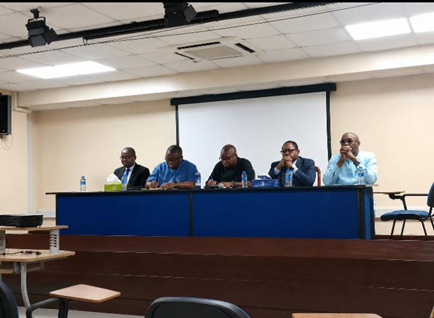
The announcement was made during a press briefing held on Wednesday, 17th June 2026, at the Sam Bangura Building on Gloucester Street in Freetown. The briefing brought together senior officials from the Bank of Sierra Leone and Rokel Commercial Bank, including the Managing Director of RCB.
Addressing journalists, Bank Governor Mr. Ibrahim Stevens explained that the decision to place Union Trust Bank under resolution was not a corporate takeover but a statutory action required under the Banking Act 2019 after the bank became insolvent and failed to meet regulatory requirements.
According to Governor Stevens, UTB had persistently failed to meet the minimum paid-up capital requirement prescribed by law. He noted that while the minimum capital requirement for commercial banks was increased from Le30 billion in 2019 to NLe270 million in 2024, UTB’s paid-up capital stood at only NLe33.82 million as of December 2025, far below the NLe122 million required under the first phase of the capital framework.
He further disclosed that the bank had accumulated retained losses amounting to NLe328.52 million, resulting in a significantly negative capital position. To meet regulatory requirements, UTB would have needed to raise approximately NLe450.52 million by December 2025, a figure that would have increased to NLe598.52 million by December 2027.
“This was clearly an insolvent financial institution,” Governor Stevens stated, explaining that UTB lacked sufficient assets to cover its liabilities if all depositors demanded their funds at the same time.
The Governor revealed that the Bank of Sierra Leone had spent more than five years attempting to assist UTB in restoring its financial health. In September 2020, the central bank placed UTB under enhanced supervision and deployed a resident examiner to closely monitor its operations.
During that period, the bank’s shareholders and management were directed to inject additional capital, strengthen governance and risk management systems, improve asset quality, and restore profitability. However, despite these interventions, shareholders were unable to recapitalize the institution, and no credible recovery plan was successfully implemented.
As part of Sierra Leone’s financial sector reform programme supported by the International Monetary Fund (IMF) and the World Bank, an independent diagnostic and forensic review was conducted by Ernst & Young Ghana in September 2024. The review confirmed that UTB’s condition had significantly deteriorated and found that its restoration plan had failed, asset quality had worsened, and there were no realistic prospects for recapitalization under the existing ownership structure.
Governor Stevens said these findings reinforced the Bank of Sierra Leone’s assessment that UTB could no longer continue operating as a viable commercial bank.
To address the situation, the Bank of Sierra Leone undertook a series of measures throughout 2024 and 2025, including engaging potential investors, developing a purchase and assumption framework, consulting international partners, and identifying a suitable acquiring institution.
Following a comprehensive assessment, Rokel Commercial Bank was selected as the acquiring institution.
The Governor disclosed that on 8th December 2025, UTB was formally placed under resolution for six months, with a caretaker management team appointed to oversee the transition. An intermediary institution, KPMG Sierra Leone Limited, was subsequently appointed to facilitate the completion of the resolution process.
Under the arrangement, all customer deposits and performing assets of UTB have been transferred to Rokel Commercial Bank, while non-performing and impaired assets remain under the custody of the intermediary institution for recovery.
Governor Stevens emphasized that no depositor has lost money as a result of the resolution process, noting that the Government of Sierra Leone agreed to cover any funding gap necessary to protect depositors and maintain financial stability.
“As we speak today, no depositor at Union Trust Bank is out of pocket,” he said.
He also issued a strong warning to defaulters whose loans contributed to the bank’s financial difficulties, stating that the Bank of Sierra Leone and the intermediary institution would aggressively pursue the recovery of all non-performing loans and collateral.
The Governor further addressed concerns regarding UTB employees, announcing that all staff would be transferred to Rokel Commercial Bank as part of the transition arrangement. He added that the Government of Sierra Leone had agreed to fund end-of-service benefits for UTB employees because the bank lacked the financial capacity to meet its obligations.
According to Governor Stevens, the transfer process was successfully completed on 16th June 2026, and as of midnight on 17th June, Union Trust Bank officially ceased to exist as a licensed financial institution in Sierra Leone.
He maintained that the action was lawful, necessary, and fully compliant with the Banking Act 2019, particularly provisions relating to insolvency, unsafe banking practices, and depositor protection.
“The successful completion of the transfer process marks an important milestone in strengthening the resilience and stability of Sierra Leone’s financial sector,” Governor Stevens concluded.
The Bank of Sierra Leone assured the public that the resolution was undertaken solely to protect depositors, preserve confidence in the banking system, and safeguard economic stability.