

There is something both beautiful and uncomfortable about watching one of your own shine far away from home. Beautiful, because brilliance has no borders. Uncomfortable, because sometimes, neither do our limitations.
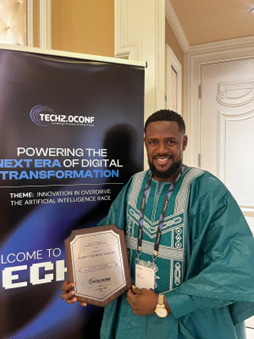
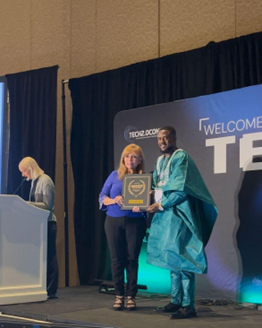
When Sierra Leone born AI innovator Albert Patrick Sankoh mounted the stage at the Tech 2.0 Conference 2026 on 8th April in Las Vegas to receive the “Trendsetter to Watch” award, it was a huge personal victory. But it was also a quiet, powerful reminder that Sierra Leoneans are not short of genius; we are only short of opportunities. At the iconic Bellagio Hotel, where the world’s tech elite gathered under the theme “Innovation in Overdrive: The Artificial Intelligence Race,” Sankoh
stood among global minds shaping the future. He was not there as an observer. Neither was he there as a participant. He was the one to watch.
From the corridors of Prince of Wales School at Kingtom to global innovation hubs, Sankoh’s journey is not accidental. It is the familiar Sierra Leonean story: talent forged in constraint, ambition sharpened by scarcity, and resilience built in a system that rarely gives you everything you need. And yet, somehow, some still overcome the hurdles and rise.
As a full-stack developer and AI specialist, Sankoh has quietly built solutions that speak louder than any speech; from digital payment systems, lending platforms, healthcare intelligence tools, to enterprise solutions that are solving real-world problems across industries. Through companies like Yestech Solutions and EZ-Tech LLC, he is coding and constructing relevance.
Sankoh’s work in AI-powered platforms like ‘HomewiseAI’ and real estate analytics is part of a global shift toward smarter, data-driven systems. In simple terms, the future is being written, and one of the writers is our proud compatriot.
But here is where the story turns. Because while we celebrate Sankoh, we must also confront ourselves. Why do our brightest minds often have to leave before they are seen? Why must Sierra Leonean excellence first be validated abroad before it is acknowledged at home?
This is Sankoh’s story, but it is actually the story of a generation. A generation that refuses to be limited by geography, but is still largely shaped by it.
The global AI ecosystem offers something Sierra Leone is still struggling to provide: tools, infrastructure, investment, and scale. And so, like many before him, Sankoh had to leave. He did not just choose to leave. That is the uncomfortable truth we rarely say out loud.
Yet, there is something deeply reassuring about this journey. Because even from Boston, even from Las Vegas, even from the heart of global innovation where Sankoh now sit comfortably, home is never completely left behind. Every system built. Every line of code written. Every problem solved, carries a quiet echo of where it all began: in Sierra Leone.
Sankoh himself puts it best: ‘This recognition is not just about me. It is about possibility. The possibility that African innovators, Sierra Leonean innovators, can lead globally.”
But leadership must also circle back. Because the real victory is not only in leaving and succeeding. It is also in creating pathways so others do not have to leave to succeed.
The real question is whether Sierra Leone is prepared to convert these moments of pride into a strategy for progress. Can we build systems that nurture talent locally? Can we create pathways where innovation does not require exit? Can we transform brain drain into brain circulation?
Because the true measure of national success is not how many of our best succeed abroad, but how many can succeed at home.
The rise of Albert Patrick Sankoh is a moment of pride for all Sierra Leoneans, young and old. It is also a mirror held up to Sierra Leone, reflecting our potential, as well as our gaps.
And what we do next will determine whether it becomes a pattern, or a turning point.