


By Lemuella Tarawallie
The Parliamentary Committee on Communications, Technology and Innovation has intensified its oversight of Sierra Leone’s $50 million Digital Transformation Project, demanding greater transparency, detailed financial records, and clear evidence of implementation progress.
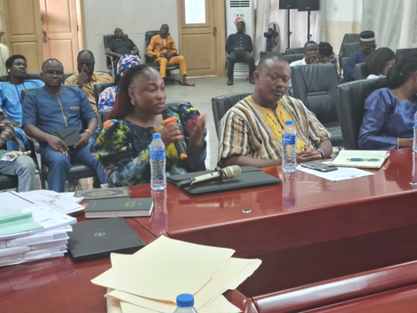
During a lengthy engagement with officials from the Ministry of Communication, Technology and Innovation and the Digital Sierra Leone Project, Members of the Committee raised concerns over procurement processes, project sustainability, service delivery, and the pace of implementation.
Chairperson of the Committee, Hon. Boston Munda, reminded officials that Parliament ratified the grant and therefore has a responsibility to ensure the project delivers value for money.
“Parliament approved this grant and it is therefore our responsibility to question the project and its processes,” Hon. Munda said. “We want to see the documents because this Committee is mandated to supervise the entire process.”
The Chairman further demanded access to project documents, including studies and procurement records, stressing that Parliament must independently verify claims made by project managers.
Responding to concerns raised by Committee members, Digital Sierra Leone Project Coordinator, Kumba Liliana Musa, explained that the grant is focused on three major objectives: expanding connectivity to underserved communities, developing digital skills among citizens, and improving the delivery of public services through technology.
“This project is built on three pillars: connectivity, digital skills and digital services,” Musa said. “We aim to improve connectivity for 500,000 citizens, train 2,000 young people, and deploy at least five new electronic government services.”
She disclosed that the first three and a half years of the five-year project were largely devoted to feasibility studies, needs assessments, and procurement preparations required under World Bank procedures.
“Digital transformation is a major national undertaking,” Musa explained. “The Bank insisted on comprehensive feasibility studies before implementation. We have now completed those studies and moved fully into implementation.”
According to her, nine major activities are currently under procurement or approaching contract signing. These include the development of an Electronic Document Management System, establishment of a government data centre, procurement of information technology equipment for Parliament, and construction of a Government Wide Area Network to connect public institutions through fibre infrastructure.
Musa also revealed that Parliament’s digital transformation requirements were assessed at approximately $7.6 million, though limited project resources meant some priorities had to be scaled down.
Deputy Chairperson of the Committee, Hon. Ing. Fallah Tengbeh, focused his questioning on procurement transparency and contractor selection procedures.
“How did you arrive at getting the most responsive contractors?” he asked.
Hon. Tengbeh further sought clarification on whether contracts were awarded based on technical competence, financial considerations, or a combination of both. He also questioned whether ongoing activities remained consistent with the original procurement plan and feasibility studies.
In response, Musa assured the Committee members that procurement follows internationally recognised standards.
“For contracts above $500,000, the World Bank conducts prior reviews of all evaluation reports,” she said. “We maintain transparency throughout the process, and any revision to procurement plans must receive approval from both the Bank and the Steering Committee.”
Committee member Hon. Dr. Unpha Gbassay Koroma challenged project managers to explain the broader national vision behind the investment and how its benefits would be sustained after implementation.
“What is the overarching goal of this digital transformation for Sierra Leone?” Hon. Koroma asked. “How do we ensure sustainability, including software support, data protection and long-term maintenance? Where do you see this country in five to ten years after this investment?”
He noted that while $50 million may appear substantial, it should be viewed as an initial investment laying the foundation for future phases of digital transformation.
Responding, Musa said the project’s success would be measured through clear indicators agreed with the World Bank.
“We are working towards improving connectivity for 500,000 citizens, training 2,000 young people, and delivering five new digital government services,” she stated. “These are measurable outcomes that will determine the project’s success.”
She added that investment decisions are guided by access gap surveys, population density, road networks, electricity availability, and other development indicators.
Another Committee member, Hon. Mustapha Musa Sellu, expressed concern about underserved communities that continue to lack internet connectivity despite years of telecommunications expansion.
“I come from an area that has existed for more than twenty years without internet connectivity,” Hon. Sellu said. “Can we have a detailed procurement plan, a complete list of service providers, contract amounts, and implementation status?”
He also criticised the absence of detailed financial reports in documents submitted to the Committee.
“Some of us like seeing figures, and when we see figures we want to verify them,” he noted. “The detailed financial reports requested by Parliament are not attached to this document.”
In closing, the Committee Chairperson Hon. Boston Munda instructed project officials to submit updated financial statements and all outstanding documents before the Committee reconvenes.
“The financial documents submitted are not the ones required for our review,” Hon. Munda stated. “Submit the correct documents by Tuesday next week, after which we will continue discussions on both the agreement and the financial records.”
The Committee’s engagement reflects Parliament’s determination to ensure accountability, transparency, and tangible results from one of Sierra Leone’s most ambitious digital development initiatives.
With only one and a half years remaining before the grant expires, Committee members signalled that they will closely monitor implementation to ensure promised reforms translate into real improvements in connectivity, digital services, and technological innovation across the country.
znmpjfevphpuulpostqksellzxktyp