

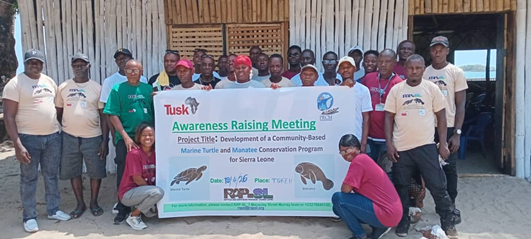
The Reptile and Amphibian Program–Sierra Leone (RAP-SL), on Saturday 18 April 2026, organized a one-day awareness-raising campaign along the Western Area Peninsula shoreline of Sierra Leone on sea turtles, manatees, and mangroves at the Ocean View Centre, Tokeh.
The aim of the campaign was to ensure that sea turtles and manatees are protected in accordance with the wildlife laws of Sierra Leone. Within the Turtle Islands, the local fine for killing a sea turtle is Six Hundred Leones (Le 600). The Fisheries Bill of Sierra Leone also provides for fines and jail terms for the killing of threatened and endangered marine species. Therefore, in order to raise awareness among local communities about these laws and penalties, RAP-SL annually engages coastal communities on conservation measures put in place by the Government of Sierra Leone.
For the present workshop, participants including headmen, harbour masters, and monitors from Tokeh, Tombo, One Pole, Kent, Borbor, York, Aberdeen, and Black Johnson were brought together in Tokeh. Together, they made salient inputs for the protection of the two species and their habitats in Sierra Leone. Some recommendations advanced by participants included regular awareness campaigns on conservation of the species and their habitats, support for coastal communities in diverse ways, and assistance to community youths in monitoring efforts.
According to the Founder and Managing Director of the program, Mr. Edward Aruna, RAP-SL started in 2012 and has since been conducting such engagements annually. However, due to limited funding in recent years, most activities have been reduced, including the work of monitors, who are volunteers.
Mr. Aruna encouraged all participants to take action toward the protection and conservation of Sierra Leone’s natural resources, including sea turtles, manatees, and mangroves. He further informed participants that all threatened and endangered species are protected worldwide and should therefore not be killed. Sea turtles and manatees should be released if caught, while mangroves should be protected for a healthy marine environment.
He also informed the gathering that RAP-SL continues its sensitization campaigns through the distribution of awareness materials, including billboards, calendars, T-shirts, and brochures, all aimed at supporting the Government of Sierra Leone in raising public awareness.
RAP-SL is also working with local fishermen and youths as turtle monitors for the enforcement of laws protecting turtles, manatees, crocodiles, mangroves, and other protected species in the country.
Mr. Aruna further disclosed that the organization conducts annual monitoring to determine the number of sea turtles and manatees caught as bycatch, while also monitoring nesting beaches. He noted that there are seven species of sea turtles worldwide, five of which are found in Sierra Leone, all of which nest on beaches in the country.
He explained that sea turtle nests are adversely affected by climate change, resulting in the hatching of more females than males. A disproportionate number of females could potentially lead to a decline in the population.
Regarding manatees, he said the cutting of mangroves, coastal erosion, coastal siltation, and fishing in breeding and foraging areas are affecting their population in the country. He added that manatees typically give birth to one calf, though in rare cases twins may occur. They feed on mangroves, seaweed, and grasses.
In Sierra Leone, the revised Wildlife Act classifies both sea turtles and manatees as protected species; therefore, they are protected by law.
As a means of benefiting coastal communities, RAP-SL has over the years constructed office spaces, water wells, community centers, over 100 improved ovens, provided solar lights, and supported schools in its operational areas. RAP-SL hopes to continue in this direction.
Highlights of the well-attended and highly interactive session included question-and-answer discussions and recommendation sessions.