

966 People, 400 Structures Affected by Urban Renewal Plan
By Ishmail Saidu Kanu
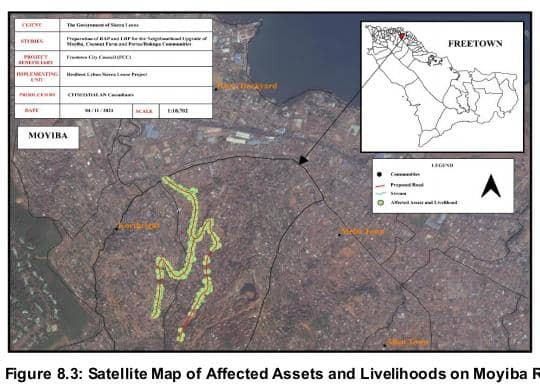
The World Bank-funded Resilient Urban Sierra Leone Project (RUSLP) has identified 966 Project Affected Persons (PAPs) in Moyiba, Coconut Farm, Portee-Rokupa and along the Bai Bureh Road corridor in Freetown, following an assessment of the potential social and economic impacts of planned infrastructure improvements.
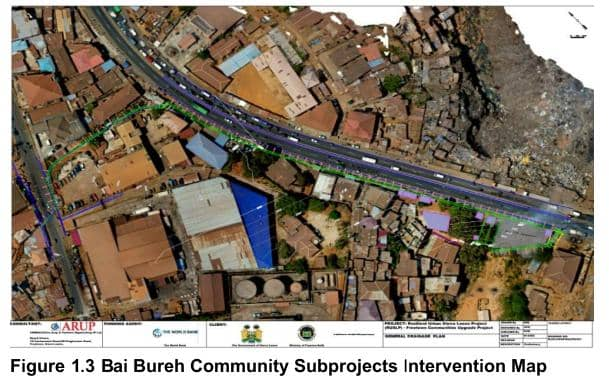
According to the Resettlement Plan prepared by the Project Management Unit in July 2026, the proposed interventions include drainage, road and water, sanitation and hygiene (WASH) works intended to mitigate flooding, address erosion and improve access to essential services in the targeted communities.
The assessment identified 400 structures that may be affected by the proposed works. These comprise residential, commercial, mixed-use, uncompleted and institutional structures.
The report indicates that 68 residential structures, 44 commercial structures, 13 mixed-use buildings and four uncompleted structures are expected to require complete removal, while other affected structures may be subject to partial modifications or setbacks.
The Resettlement Plan sets out the proposed framework for addressing displacement and other adverse impacts arising from the project. It provides for compensation at full replacement cost, where applicable, together with relocation and transitional assistance for eligible affected persons and businesses. It also envisages livelihood restoration measures intended to assist eligible persons in re-establishing their income-generating activities.
The assessment further identifies 265 vulnerable households or individuals who may require additional assistance. The categories identified include widows, elderly persons, single mothers, persons with disabilities and low-income households.
On the question of compensation, the report records a preference among consulted community members for cash compensation. This preference was attributed to the reported unavailability of suitable replacement land within the affected communities and concerns regarding the suitability of alternative locations.
The implementation of compensation and resettlement measures will therefore need to be guided by the applicable project framework and the entitlements established under the Resettlement Plan.
The estimated cost of implementing the plan is approximately US$1.66 million. The allocation is intended to cover compensation, livelihood restoration, assistance to vulnerable groups and grievance management.
Institutionally, the project is being implemented through the Project Management Unit under the Ministry of Finance, with the Freetown City Council serving as the beneficiary.
The implementation of the proposed works is expected to improve drainage, road access and essential services in the targeted communities.
However, the project’s social safeguards will be critical to ensuring that affected persons receive the compensation and assistance to which they are entitled, and that any grievances arising from the resettlement process are addressed through the established mechanisms.