


Tacugama Chimpanzee Sanctuary’s Community Outreach Programme (TCOP) delivered a targeted education and engagement mission to communities surrounding Outamba-Kilimi National Park (OKNP), aimed at strengthening youth awareness of chimpanzees, biodiversity conservation, and the role healthy ecosystems play in sustaining local livelihoods.
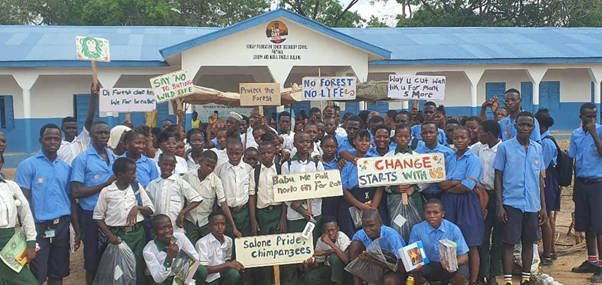
TCOP operates at the intersection of conservation and community development, delivering formal and informal environmental education, supporting sustainable livelihoods, and fostering long-term stewardship among communities living alongside critical habitats. This mission formed part of TCOP’s strategy to engage schools in high-biodiversity landscapes, where pressures on wildlife, particularly chimpanzees, are closely linked to human activity.
The team departed Freetown on March 22 and implemented a structured programme combining classroom-based learning, interactive competitions, community outreach, and field-based experiences.
A two-day Environmental Day, one for primary school pupils and another for Junior and Senior Secondary School students, was held in Fintonia and served as the core platform for youth engagement. The event reinforced environmental knowledge while building confidence, creativity, and leadership among students. It targeted pupils enrolled in Tacugama’s Conservation Education Programme (TKEEP) within the Outamba region.
TKEEP is a formal education programme that supplements the national curriculum, with a focus on human–wildlife coexistence. It is delivered by local teachers with support and mentorship from Tacugama’s education specialists.
The secondary school programme brought together students, educators, and community leaders, including the Section Chief, ensuring strong local ownership and visibility. Students participated in debates on environmental issues, delivered speeches on conservation themes, and presented poetry reflecting human–wildlife relationships. These activities encouraged critical thinking, public speaking, and a deeper personal connection to conservation topics covered during TKEEP lessons. All participants received certificates, with top-performing students awarded prizes.
In the evening, boys’ and girls’ football matches created a well-attended community event. These matches served as an entry point for broader outreach, with conservation messages delivered in an engaging and accessible format through commentary by DJ Buju. The integration of sport and education extended awareness beyond the classroom and into the wider community.
Primary school pupils from surrounding communities, including Sumatha, Yana, Kotor, and Fintonia, were supported to attend, ensuring inclusivity and early engagement with conservation education. Activities included wildlife-themed colouring and word games to build ecological awareness, as well as spelling bees and quiz competitions to reinforce key concepts learned in class. All pupils received certificates and prizes, promoting a sense of achievement. Safe transportation and meals ensured full participation and accessibility.
In addition to the Environmental Day activities, the TCOP Education Team was joined in Outamba by Mr. Renato Granieri, a renowned wildlife photographer and long-time supporter of Tacugama, along with accompanying guests, to observe and learn more about TCOP’s work in the region.
Key highlights of Renato’s visit included observing a forest ecology workshop titled “The Lung and Heart of Our Planet,” delivered to JSS and SSS students. The session deepened understanding of ecosystem services such as climate regulation, water cycles, and biodiversity support. The visit also included field trips to farms affected by elephant activity, illustrating human–elephant conflict. Renato observed tracks, dung, and movement corridors between community forests and agricultural areas.
Human–elephant conflict occurs when elephants and people compete for the same space and resources, often in areas where farms and settlements overlap with elephant habitats. One of the most common forms is crop raiding, where elephants feed on crops such as rice or bananas, sometimes destroying entire fields in a single visit. This can lead to food insecurity, loss of income, and increased tension, occasionally resulting in injury or loss of life for both people and elephants.
The team also monitored beehives linked to alternative livelihood initiatives, demonstrating how conservation efforts can align with income generation. Renato’s visit further strengthened collaboration with external partners, reinforcing TCOP’s role as a platform for integrated conservation action.
The mission reached a broad cross-section of students and community members, delivering multiple layers of impact. Environmental awareness increased among both primary and secondary students, particularly regarding chimpanzees and ecosystem functions. Youth engagement was strengthened, with students actively participating in and leading conservation discussions. Community sensitization was enhanced through sport and public events, extending messaging beyond schools. Understanding of human–wildlife interactions improved, especially in relation to elephant activity in the landscape. Links between conservation and livelihoods were reinforced through exposure to initiatives such as beekeeping.
By combining education, recreation, and hands-on experiences, TCOP continues to foster a new generation of environmentally conscious individuals equipped to contribute to conservation efforts in their communities.
This work highlights the value of TCOP’s integrated approach, linking education, community engagement, and practical conservation to drive long-term behavioural change and support the protection of chimpanzees, elephants, and their habitats in Sierra Leone.

Heard some buzz about Masaya365app and had to give it a shot. The app is super user-friendly, and I’m digging the live casino options. Been having some decent luck lately. Check it out yourself at masaya365app!
Looking to score the phl boss app download. Is it worth the space on my phone? Heard mixed things, so looking for some honest opinions.
Can anyone vouch for ph235login? Seen some ads, but always skeptical. Hit me with the real reviews!