

By Lemuella Tarawallie
The Parliamentary Oversight Committee on Defence has partnered with the Africa Center for Strategic Studies to host a three-day Defence Oversight Capacity Building workshop at the Office of National Security in Freetown.
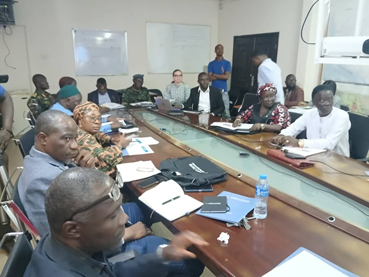
Opening the session, Chairperson of the Parliamentary Oversight Committee on Defence, Hon. Alex Mattia Rogers, described the initiative as the result of two years of planning and engagement.
“The Office of National Security, the Central Intelligence Agency, and the Commission on Arms and Ammunition are part of this process,” he said. “I have been working on this project for the past two years and I am pleased that it has come to fruition.”
Hon. Rogers recalled attending a similar programme at the War College in Washington, where the concept was demonstrated for parliamentarians, committees and national defence agencies. He explained that for the current workshop, two participants were selected from each associated agency, including representatives from the Army, Navy and Air Force, following nominations by the Minister of Defence.
“It is a composition of expertise from the national defence agencies,” he said. “The programme is about sharing experience and expertise.”
Dr. Catherine Lena Kelly, Director of Engagement at the Africa Center for Strategic Studies and co-developer of the programme, said the workshop was developed over several years with contributions from the entire Defence Committee and experts from legislative and security institutions across Africa.
She noted that the training is designed to strengthen collaboration between defence legislators and officials from the ministries, departments and agencies overseen by the committee.
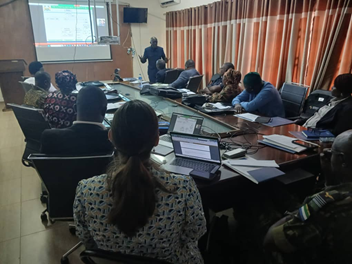
“It is comprehensive, covering a range of topics critical to the effective oversight of defence and security institutions,” she said. “It is also practical, with exercises included as part of the programme.”
According to Dr. Kelly, the workshop consists of four plenary sessions and two guided exercises facilitated by African security sector experts. She added that the Africa Center, established in 1999 and based at the National Defense University in Washington, works to advance African security through dialogue, partnerships and strategic solutions.
She also stated that a strict policy of non-attribution would apply during and after the workshop to encourage open discussions on sensitive issues.
Assistant Professor for African Security Studies at the Africa Center, Dr. Joel Amegboh, highlighted the critical role of parliamentary oversight in the defence and security sector.
“Defence and security institutions are not ordinary public agencies,” he said. “They hold instruments of national power, manage classified information, command disciplined forces and utilise significant national resources. Such authority demands serious oversight.”
He warned that weak oversight mechanisms can create gaps, including limited legislative understanding of security threats and excessive reliance on executive briefings without independent analysis.
“The purpose of this session is diagnostic and forward-looking,” he added. “National security institutions are strongest when oversight is informed, confident and consistent.”
Providing local context, Chief of Staff at the Office of National Security, Francis Keili, outlined the structure and operations of the four ministries, departments and agencies under the committee’s oversight: the Ministry of Defence, the Office of National Security, the Arms and Ammunition Commission, and the Central Intelligence and Security Agency.
He said stronger parliamentary oversight would improve accountability and strengthen public trust in the security sector.
“If we strengthen the interface between parliamentarians and the security sector, we will improve governance mechanisms in Sierra Leone,” he said. “We want practical recommendations that can be implemented after this workshop.”
Procurement specialist Francis Esimit from Kenya addressed the culture of secrecy in defence procurement and the challenge of balancing transparency with national security considerations.
“How do we ensure that the public has trust in our system through transparency and accountability?” he asked.
He noted that in many cases procurement decisions and defence spending are concealed from scrutiny, with budgets, contracts and supplier information withheld without clear justification.
“When secrecy dominates, transparency becomes limited. Parliament will be unable to perform its oversight role and public accountability will be undermined,” he said.
Former member of the Pan African Parliament, Annelize Van Wyk, shared lessons from South Africa, stressing the importance of secure briefings and whistleblower protection.
“Parliament should allocate funds and time for committees to conduct site visits,” she said. “Secure briefings are also necessary when sensitive matters are discussed.”
She warned of the risks of corruption in classified budgets, citing a case in South Africa where senior crime intelligence officials were arrested over fraud involving secret funds.
“The problem is not necessarily solved when the culprit is punished,” she said. “Parliamentary oversight is essential to ensure that public resources deliver security, development and stability.”
The workshop is expected to conclude with group presentations from representatives of the four oversight agencies, outlining practical steps to strengthen cooperation and improve defence oversight practices in Sierra Leone.