


In a meeting convened by Africa CDC, the African Union Commission, and the Government of Nigeria, heads of delegation, ministers of health and finance, and the African Union (AU) have committed to investing in and strengthening the health workforce in Africa.
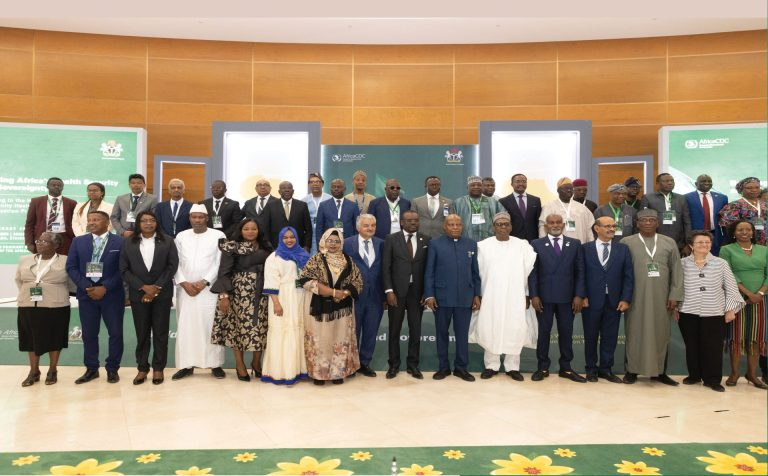
They called for an urgent and sustained investment in Africa’s health workforce, including building a two-million-strong community health worker (CHW) workforce by 2030.
According to these leaders, health investment is critical to strengthen Africa’s health security and sovereignty (AHSS) and accelerate progress toward Universal Health Coverage (UHC).
H.E. President Bola Ahmed Tinubu, H.E. Kashim Shettima, Vice President of Nigeria, speaking on behalf of the AU Champion for Human Resources for Health and Community Health Delivery Partnership, said: “Africa cannot achieve universal health coverage or protect its people from pandemics without investing in its health workforce.” He added, “Sovereignty without standards is not sovereignty; it is exposure to risk.”
The World Health Organization (WHO) projects a shortfall of over six million health workers by 2030, threatening progress in immunisation, outbreak detection, and the delivery of essential primary health care, including maternal and child health, chronic disease management, and access to preventive and curative services. Despite carrying more than 25% of the global disease burden, Africa faces a severe shortage of health workers.
Closing this workforce gap is essential for achieving universal health coverage and improving health outcomes across Africa.
Speaking to the audience, Professor Muhammad Ali Pate, Coordinating Minister of Health and Social Welfare, reported that Nigeria is committed to leading by example: “By 2027, we aim to deploy 100,000 salaried Community Health Workers nationwide, integrated within our state health systems,” and reiterated the call for community health workers (CHWs) to be formally recognised, regulated, professionalised, and integrated into national health systems.
In Africa CDC’s Continental Health Workforce Investment Case, every US$1 invested in the health workforce yields up to US$19 in economic returns, while inaction could cost the continent an estimated US$1.4 trillion by 2030. An estimated US$4.3 billion annually is required to build a two-million-strong CHW workforce by 2030.
Dr. Jean Kaseya, Director General of Africa CDC, said the evidence is unequivocal; therefore, investing in Africa’s health workforce is not a cost, but a strategic investment in health security and economic resilience. He called on leaders present to fast-track and be robust in investing resources in the health workforce system in Africa.
In his words, Professor Julio Rakotonirina, Director for Health and Humanitarian Affairs, says: “AU Commission is committed to building a stronger health workforce by working closely with partners and Member States to address key challenges and advance professionalisation, guided by a Continental Framework and Acceleration Plan across Africa.”
In a survey from Africa CDC–UNICEF, 1.042 million CHWs were deployed in 2024. However, CHW density remains at 7.5 per 10,000 population—far below the benchmark of 25 per 10,000 defined by Africa CDC as a threshold to achieve the Universal Health Coverage (UHC) target of 70 percent by 2030.
Only six countries finance more than 80% of their CHW programmes domestically, and 16 countries offer structured career pathways.
Leaders urged Member States to integrate health workforce investments into national budgets, protect frontline spending, strengthen coordination between health and finance ministries, and fully implement continental accountability mechanisms, including the AU Health Workforce Compact and the Continental Community Health Scorecard. They further directed Africa CDC and the Continental Coordination Mechanism for Community Health to convene in Abuja before June 2026 to launch the Continental Acceleration Plan and replenish national acceleration plans for CHWs in a Communiqué adopted on the 13th of February 2026.
Jilliko, pretty smooth experience. The site’s easy to navigate and I found some games I actually liked. Could use some more variety, but not bad at all. See for yourself: jilliko
Leaobetlogin, man, it’s got that vibe, you know? Quick sign-up, decent games. Feels solid for a late-night session. Check it out: leaobetlogin
Signed up to win656bet. The bonus looks good. I just hope it is easy to withdraw funds. Let’s hope for the best. Check it out yourself win656bet