

By Zainab Sunkary Koroma
Kono District, located in the eastern region of Sierra Leone, is best known for its diamond riches, which have been explored since the early 1930s when the first precious stone was discovered.
Rather than being a blessing, many believe that diamonds have become a curse to the people of Kono, who say their rights are daily abused by mining companies and their collaborators.
Octéa Limited, owned by BSG Resources and ultimately by Israeli billionaire Beny Steinmetz, operates Koidu Limited in Kono District with extensive diamond-mining operations.
After Sierra Leone’s civil war, the company began operations on land occupied by seven villages. An agreement was made where residents would be resettled into new homes said to be of equal or better quality, with the provision of infrastructure such as schools, hospitals, and amenities to improve their lives. While the resettlement process did begin, major issues quickly emerged.
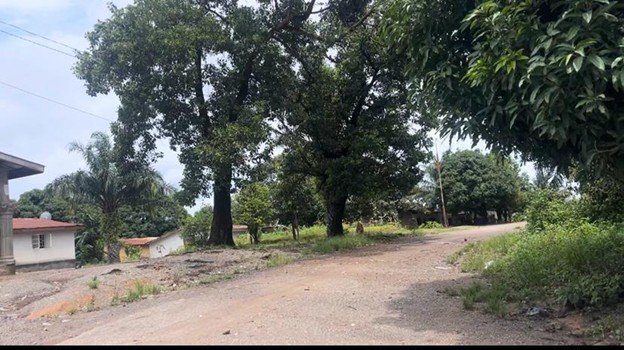
Many of the new houses were substandard. Walls developed cracks shortly after construction. Promised amenities, schools, hospitals, water, and electricity, were either slow to appear or poorly delivered. Some residents allege that what was provided was far inferior to what had been promised. Roads remain underdeveloped, while access to water and electricity is either unreliable or entirely absent.
Stay up-to-date with our latest news updates. Don’t miss out on important news!
It was clearly stated in the Truth and Reconciliation Commission Report of 2004 that minerals were one of the root causes of the bloody civil war that lasted more than a decade and claimed over 50,000 lives in Sierra Leone.
AGGRIEVED PEOPLE
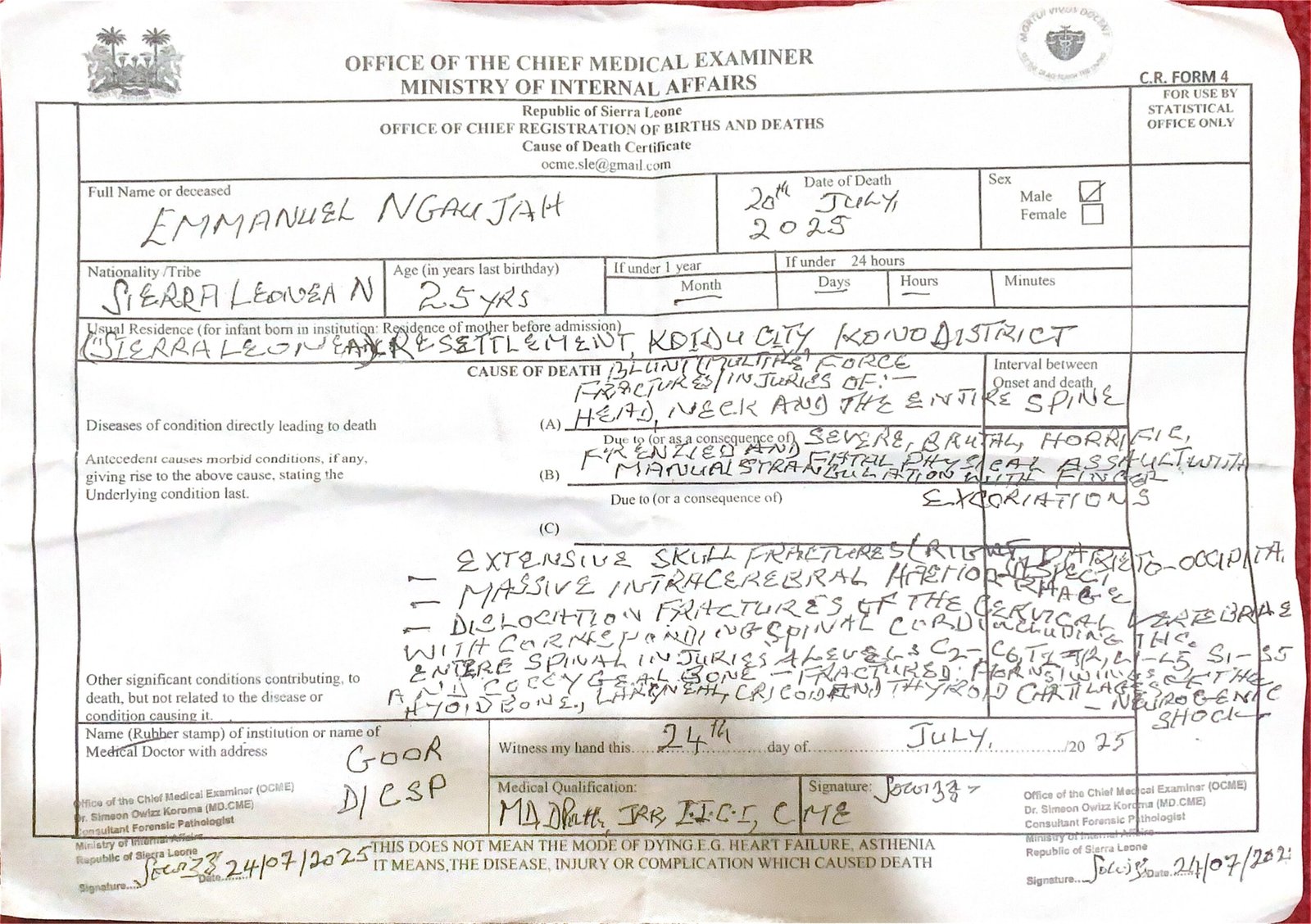
Gbama Ngaujah, a resident of the relocated community and a retired staff member of the company (after 15 years of service), suffered a heartbreaking tragedy. His son, Emmanuel Ngaujah, was allegedly brutally killed at the Koidu Holdings site by four OSD officers guarding the area.
According to Gbama, he was out of town on July 21, 2025, when he received a call informing him of his son’s death. Upon arrival, he went to the hospital where the body had been taken and was told it was in the mortuary. Upon identifying the body, he saw bruises, scars on the hands, and head wounds.
He reported the incident to the police and requested an autopsy before burial.
A preliminary autopsy was conducted, but the doctor could not perform a full examination. A report was sent to the police. Just before burial, police officers and the chief informed Gbama that the Inspector General of Police had ordered a proper autopsy be conducted in Freetown. Gbama sent three representatives. The autopsy revealed brutal injuries; broken ribs, spinal damage, and stab wounds to the chest and head.
The police allegedly dropped the body at the hospital after he had already died. The matter is now in court. Two officers are in custody. The police carried out their own disciplinary procedures before handing them over to the courts. As a grieving father, Gbama says all he wants is justice.
COURT PROCEEDINGS IN KONO
At the Magistrate Court in Kono District, before Resident Magistrate Victor S.S. Ansumana, two OSD police officers, PC 22791 Bai Sesay and PC 22822 Sulaiman Kargbo, were arraigned on charges of conspiracy and murder, contrary to Section 1 of the Offences Against the Person Act 1861, as repealed and replaced by Section 1(A) of the Abolition of the Death Penalty Act No.6 of 2022. Both allegedly conspired with unknown persons to murder Emmanuel Ngaujah.
Emmanuel’s death has drawn serious attention from family, civil society, and community stakeholders in Kono. It’s alleged he was caught inside the mining concession area.
The affected community says their livelihoods have been destroyed, their air and water polluted, and their ancestral lands taken without proper compensation.
Martha Fear, a community spokesperson, said her community was among the seven villages relocated. While they were promised improved living standards, what they received fell short. Houses were of poor quality, schools were few, and water infrastructure was tied to company power supplies, meaning no electricity, no water.
Now that the company has shut down operations, the community has been left with
no water source. “We have to walk miles to fetch water. Back in my old village, I had two wells,” she said.
She added, “It’s been over 15 years since the relocation, but there has been no meaningful development. The hospital is beautiful on the outside but a mess inside with no water, no electricity, no functioning solar panels, no pharmacy. Women give birth using water from the stream.”
Blasting from the mine used to shake their homes. The roads are in terrible shape despite being in the heart of a major mining area. Worse still, they
have no documentation for the houses provided, raising fears that the company may one day claim the land back.
She also pointed out that while residents were promised jobs, few were hired. Those who worked at the site faced abuse and exploitation. “When I hear about their suffering, I cry. This company is evil.”
VOICES OF PROTEST
Komba Emmanuel Soka, a Kono native and miner, explained that mining has existed in the area for generations, yet Kono remains underdeveloped. Companies like BSG Resources came and left without contributing anything sustainable.
“Every government has treated Kono like a hunting ground. The strong survive, and we, the people of Kono, are not surviving. It’s not because we lack educated people but because they compromise.”
He called on the leaders of Sierra Leone to take inspiration from Burkina Faso’s President Ibrahim Traoré, who advocates for national control of resources. “From 1938 to now, there’s nothing to show for it. We are the sacrificial lambs fighting for historical justice.”
CIVIL SOCIETY & LEGAL PERSPECTIVES
Ibrahim A.S. Bockarie, District Coordinator for Kono Organization and Director of the Concerned Citizen Governance Network, described mining in Kono as a ‘mixed and disheartening story’.
Despite diamonds being discovered in 1930, ‘even the basics, like understanding the mining process, remain inaccessible to locals. Foreigners dominate mining in Sierra Leone, and our universities are disconnected from the industry. That’s why this ‘resource curse’ persists,” he explained.
He noted that locals have no control over mineral wealth. Electricity is still unreliable, there’s no university in Kono, and access to clean tap water remains a dream. “We’re sitting on riches, but we’re not living in them,” he lamented.
LEGAL BATTLE: MAPO VS. OCTÉA/KOIDU HOLDINGS
Legal practitioner Emmanuel Michael Tommy Gbondo Esq. explained that land safety and resource management lie with the state. He’s aware of the community’s struggles and represents the Marginalized Affected Property Owners (MAPO) in their ongoing legal battle against Octéa.
Supported by Network Movement for Justice and Development (NMJD), MAPO’s class-action lawsuit began in 2019. Aiah Fengai and 73 other residents sued for environmental damage, destruction of homes, livelihood losses, improper resettlement, and water contamination.
The case was refiled in the Makeni High Court in 2020 but was dismissed in 2022 on grounds that MAPO lacked legal standing. The Court of Appeal, however, reversed this in 2024, allowing MAPO to proceed.
In 2025, the Court of Appeal issued an injunction preventing Koidu/Octéa from selling or moving assets until the case is resolved.
Gbondo noted that current laws make it difficult for communities to sue companies. For instance, privity of contract says only parties directly involved in a contract can take legal action. Companies exploit this by claiming they have no contract with the community; only with the government.
He stressed the need for laws that clearly define land ownership and community rights. ‘Until then’, he said, “our people will continue to suffer under vague contracts and unenforceable promises.”
This investigation was supported by BBC Media Action and funded by Deutsche Gesellschaft für Internationale Zusammenarbeit (GIZ) GmbH on behalf of the German Federal Ministry of Economic Cooperation and Development (BMZ), and co-funded by the European Union (EU