

By Princetta Williams, Information Attaché, SLHC, Accra
As West African leaders agreed on an extensive agenda to strengthen regional security cooperation, a Consultative Conference on Regional Cooperation and Security for Heads of State ended in Accra with a robust call for action.
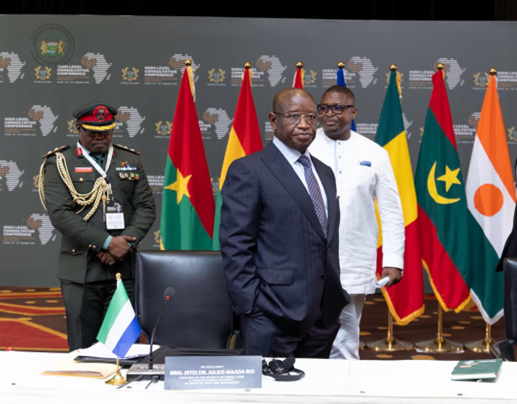
The two-day conference, held from 29–30 January 2026 at the Kempinski Hotel in Accra, brought together Heads of State and Government from some West African countries in the region, including Sierra Leone.
Chairing the conference were President John Dramani Mahama of Ghana, President Joseph Boakai of Liberia, and Dr. Julius Maada Bio of Sierra Leone.
Making his presentation on behalf of Sierra Leone and its delegation, His Excellency President Julius Maada Bio commended the government of Ghana for hosting such a conference, which aims at addressing issues of terrorism in the West Africa region.
He said West Africa stands at a defining moment, as the current state of terrorism, especially in the Sahel states, is worrisome.
President Bio cautioned that terrorism and violent extremism in West Africa have reached an unsafe stage, where armed groups are no longer just testing states but are actively looking for ways and opportunities to dismantle them.
“This moment demands coordinated and decisive action,” he said, thanking his colleague President John Dramani Mahama for stepping in to convene leaders at a critical moment.
In a joint communiqué issued at the closing session, the Minister of Foreign Affairs, Samuel Okudzeto Ablakwa, revealed that the West African leaders accepted that West Africa has become the global epicentre of terrorism and violent extremism, with at least eight attacks daily and accounting for more than half of the deaths worldwide linked to terrorism.
The communiqué emphasised that the region’s unified layout, common trade routes, and cross-border communities make coordinated responses inevitable, warning that continued disintegration carries heavy economic, social, and security costs.

As a way of addressing these challenges, participants agreed to create a planned and enduring framework for regional cooperation, moving outside core mediation and limited working harmonisation.
On security and counterterrorism, the conference resolved to strengthen intelligence and information sharing, harmonise legal frameworks for cross-border prosecution of terrorism-related offences, and scale up de-radicalisation programs, while safeguarding human rights.
Leaders are committed to intensifying efforts against trafficking.
On the matter of border security, the meeting agreed to consider detection arrangements through bilateral or multilateral agreements to combat the relatively easy movement of extremist and criminal networks.
Minister Ablakwa, the Foreign Affairs Minister of Ghana, was tasked to lead the process of drafting a foundational Memorandum of Understanding within three months, with a view to final adoption within six months.
Beyond military measures, the communiqué emphasised a shift towards a human security approach, prioritising food security, healthcare, education, job creation, and inclusive governance.
Leaders also pledged to strengthen local governance to ensure state presence is felt through service delivery, not only security enforcement.
As part of the next steps, the leaders endorsed the consultative conference as a biannual platform and agreed to establish a monitoring mechanism to track the implementation of agreed outcomes.
His Excellency President Julius Maada Bio was accompanied by the Minister of Foreign Affairs, Musa Timothy Kabba; the Internal Affairs Minister, Morie Lengor; Sierra Leone High Commissioner in Accra, Ghana, Mohamed Hassan Kaisamba; Chief of Defence Staff, Lt Gen Amara Idara Bangura; and Brigadier General Sheikh Sulaiman Massaquoi, Designated Chief of Staff of the ECOWAS Standby Force in the ECOWAS Commission.