

By Mohamed Lamin Banya
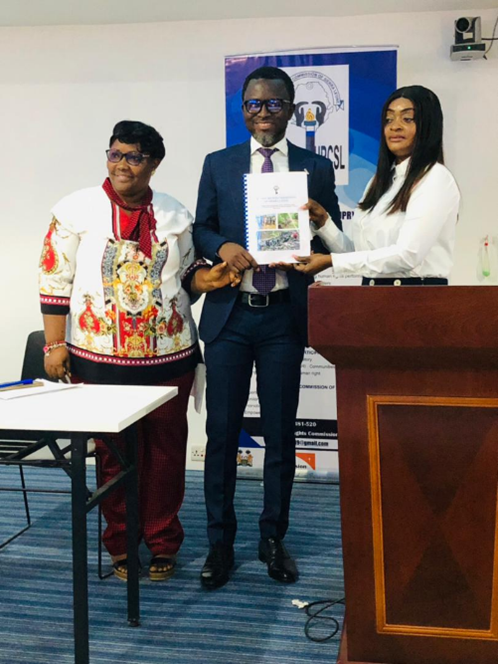
The Human Rights Commission of Sierra Leone (HRCSL) has launched a video documentary and a report highlighting the human rights implications of kush, a highly dangerous synthetic drug that continues to threaten the lives and future of young people across the country.
Speaking at the launch, the Vice Chairperson of the Commission, Victor Idrissa Lansana, said the 30-minute documentary is part of the Commission’s collective effort to combat the kush menace, which has severe negative consequences on the enjoyment of fundamental human rights.
Mr. Lansana noted that the Commission’s involvement in the fight against kush is driven by the drug’s devastating impact on the right to health and the right to life.
“The report and the documentary clearly show how our young people are perishing and how the future of our country is being destroyed by drugs,” he said.
He explained that the HRCSL, as a constitutional body mandated to protect and promote human rights, considers the fight against kush a human rights issue that requires urgent state attention.
“We have young people who cannot go to school because of kush and other drugs. The Human Rights Commission is deeply concerned because the impact is already telling on their lives,” Mr. Lansana added.
Presenting the report and documentary, the Director of Education, Communication and Technology at the Commission, Richard Mbayo, said the primary objective of the monitoring exercise was to assess and document the human rights impact of kush abuse, particularly on vulnerable groups, especially young people.
Mr. Mbayo disclosed that the monitoring was conducted nationwide, with special emphasis on the effects and implications of kush abuse, and expressed hope that the findings would inform coordinated policies and effective interventions.
“The age bracket most affected ranges from 15 to 50 years. The methods employed included field observations and engagement with affected individuals and communities,” he explained.
According to Mr. Mbayo, findings from the report reveal that kush-affected persons are often subjected to neglect, leading to severe physical conditions such as foot sores, as well as serious mental health challenges.
“Our findings also show that law-enforcement responses tend to target users rather than dealers, which in many cases worsens the victims’ situation through mistreatment,” he said.
He further noted that rehabilitation efforts are constrained by high costs and inadequate facilities, leaving many affected individuals without access to treatment. The Commission therefore recommends the establishment of focused rehabilitation programmes that integrate medical, psychological and vocational support.
Delivering the keynote address, the Deputy Attorney-General and Minister of Justice, Saptieu Saccoh Esq., said the Commission’s findings clearly demonstrate that kush abuse does not occur in isolation but is deeply linked to poverty, unemployment, trauma, social exclusion and limited access to mental health and rehabilitation services.
She noted that the documentary vividly captures the lived experiences of users, families and communities, many of whom feel abandoned, stigmatized and trapped in a vicious cycle of despair.
“The report does not promote the use of illicit substances. Rather, it underscores a rights-based approach that recognizes substance abuse as both a public health and social concern,” Madam Saccoh stated.
She emphasized that the right to life and the right to health are gravely threatened by kush abuse, which has been linked to serious physical and mental harm, and in some cases, premature death