

By Lemuella Tarawallie
The Evangelical Fellowship of Sierra Leone (EFSL), an umbrella body of evangelical denominations and para-church organizations, through a communiqué, has lauded the government for its strides in education, healthcare, infrastructure, and agriculture but has also issued a strong warning on pressing national challenges that demand urgent government attention.
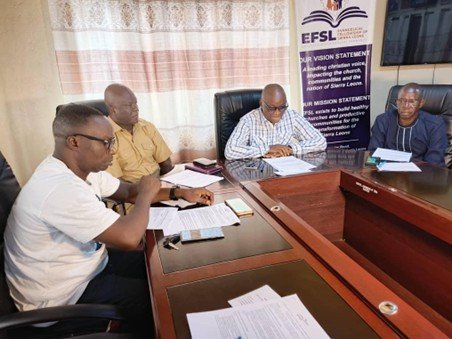
The Fellowship presented its communiqué during a press conference held on Friday, October 3, at its headquarters on Circular Road in Freetown.
EFSL Secretary General, Rev. Gaidru Bassie, who chaired the event, read out the statement officially adopted during the Fellowship’s Sixth Biennial General Assembly in Bo on September 25, 2025.
In its communiqué, EFSL commended the government for expanding access to education through the Free Quality Education initiative, noting that thousands of children are now benefiting from schooling opportunities.
It also applauded improvements in healthcare, including reductions in maternal and child mortality, as well as major infrastructure projects — roads, bridges, and rehabilitation works — that have boosted mobility and trade.
On agriculture, the Fellowship welcomed government initiatives aimed at reducing reliance on imported food, especially rice, while promoting local farming and food security.
“We urge the government to continue these positive efforts,” the communiqué stated, assuring that EFSL remains a partner in advancing Sierra Leone’s national development, the Secretary noted.
However, alongside its commendations, EFSL expressed serious concern over what it described as “critical issues threatening the nation’s stability and wellbeing.” Key among these are:
Rising economic hardship and the soaring cost of basic goods
Youth unemployment and lack of opportunities
Poor access to clean water and healthcare in rural communities
Housing shortages and the rapid growth of informal settlements
Escalating violent crime and armed robbery
Widespread drug abuse and trafficking, especially of Kush, cocaine, heroin, and diverted pharmaceuticals such as tramadol
Persistent vulnerability of the poor and marginalized
Climate change and environmental degradation
Rev. Bassie warned that these challenges are deepening poverty and public frustration: “Extreme poverty and rising costs of commodities continue to weigh heavily on citizens.”
The Fellowship condemned the surge in armed robbery and violent crime, including the killing of Rev. Father Augustine Dauda Amadu in the Eastern Province and the violent attack on Mr. Jobi Lamina, NASSTI’s South Regional Manager, in Bo City.
“These crimes threaten peace and security,” the communiqué stressed, calling for stronger policing, youth employment schemes, judicial reforms, and a revival of moral and ethical education.
EFSL further described the influx of harmful substances as a national emergency, urging the government to tighten border controls, dismantle drug networks, and invest in prevention and rehabilitation programs. It appealed to parents, communities, and religious leaders to step up drug-prevention education for young people.
The Fellowship reaffirmed its long-standing position on sensitive moral issues, stating that EFSL rejects same-sex marriage, describing marriage as “a sacred covenant between one man and one woman.” It upheld the sanctity of life “from conception to natural death,” opposing abortion except in cases where the mother’s life is endangered.
EFSL called for stronger maternal healthcare services and constitutional protections for unborn children.
On the protracted Yenga border dispute with Guinea, EFSL commended both governments for pursuing diplomatic dialogue and urged ECOWAS, the African Union, and the United Nations to support peaceful mediation.
Vice President Rev. Dr. Abraham Felix Turay cautioned against young people resorting to violence over border disputes: “Sierra Leone and Guinea are brothers and sisters. Any disagreements must be resolved peacefully through diplomatic channels.”
On climate change, the Fellowship issued one of its strongest warnings, calling environmental degradation “a national emergency requiring an unprecedented, united response.” It urged government, the private sector, and citizens alike to take collective responsibility in protecting Sierra Leone’s natural resources.
The communiqué was signed by EFSL President Rev. Dr. Shodankeh B.E.B. Johnson and Secretary General Rev. Gaidru Bassie.
EFSL pledged its continued prayers for the nation, expansion of social service programs to alleviate suffering, and constructive engagement with government and stakeholders.
Rev. Bassie stressed that EFSL’s concerns would not end at the press conference but would be followed by structured engagement with authorities.
EFSL Western Area Representative Rev. Martine Salifu Kamara echoed that the press briefing was a strategic first step: “We thank the media for amplifying this message so that both the government and the nation at large will hear our collective voice.”
Concluding the communiqué, EFSL urged Sierra Leoneans to embrace unity, peace, and reconciliation:
“We call upon all Sierra Leoneans to work together for the common good,” the communiqué maintained.