


By Lemuella Tarawallie
The Parliamentary Oversight Committee on Basic and Senior Secondary Education held a familiarisation meeting with senior officials of the Ministry of Basic and Senior Secondary Education (MBSSE), aimed at strengthening cooperation and enhancing effective oversight.
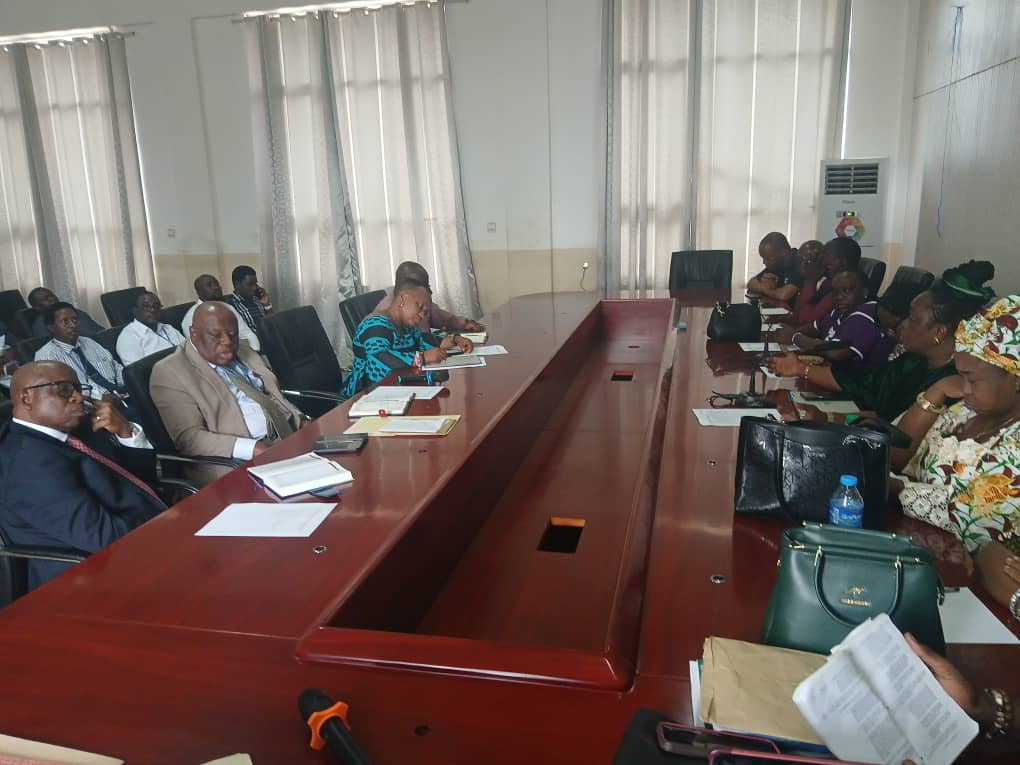
The engagement, which took place on Tuesday, 3rd February 2026, at the Administrative Building in Parliament, followed the recent reconstitution of the parliamentary committee.
Chairperson of the Committee, Hon. Rebecca Yei Kamara, said the meeting was intended to provide committee members with a broad understanding of the Ministry’s operations while formally introducing the new leadership of the committee to the Ministry’s management team.
She explained that the familiarisation was particularly important for newly appointed members, including herself as Chair, to appreciate the scope of the Ministry’s work and establish a collaborative relationship that would support Parliament’s oversight responsibilities.
Hon. Kamara described education as a critical pillar of national development and stressed that progress in the sector depends on collective effort.
“If we do not work together, there are certain goals we will not achieve. There are areas where Members of Parliament can support the Ministry, including information dissemination and ensuring that processes are followed correctly,” she said.
She noted that parliamentary committees are frequently reshuffled, adding that members’ performance often determines whether they remain on a committee or are reassigned.
“I have served on the Labour Committee for two sessions since 2023 and now on the Education Committee for this third session. I have engaged my predecessor to understand where he stopped and what remains to be done,” she stated.
The Chairperson emphasized that parliamentary oversight should not be misconstrued as intimidation.
“I am not here to be on anyone’s neck. You are professionals. I want to learn from you and see where Parliament can support the process,” she said, adding that education remains a flagship programme of the government.
She warned that failure in the education sector would be a shared responsibility, stressing that Parliament must carry out its oversight role effectively to ensure policies and laws are properly implemented.
Hon. Kamara assured the Ministry of openness and cooperation, noting that not all summons by Parliament are confrontational, as many are intended to foster dialogue and resolve challenges. She further explained that, in some cases, committee members may visit ministries directly to better understand issues affecting their constituencies, particularly in the education sector.
Responding on behalf of the Ministry, the Permanent Secretary of MBSSE, Brima Sowa, thanked the committee for the engagement and reaffirmed the Ministry’s commitment to cooperation.
“We are pleased and privileged as public servants to be invited by Parliament. Oversight is part of your mandate, and as a Ministry, we are always ready to collaborate and provide any information required,” he said.
Mr. Sowa assured the committee that his office remains accessible at all times and pledged full support to enable Parliament to effectively perform its oversight duties.
He added that the Ministry would provide documentation outlining its vision, mission, and mandate to help committee members gain a clearer understanding of its operations. He also underscored the importance of collaboration with the Teaching Service Commission (TSC), describing it as a key partner in education delivery.
The Director of Planning at MBSSE, Adama J. Momoh, presented an overview of the Ministry’s policies, reforms, and ongoing initiatives.
She noted that the Ministry operates strictly within established laws and regulations and has developed policies to guide service delivery, including school fee subsidy utilisation, school approval procedures, and school catchment areas.
According to her, admission into Senior Secondary School One is regulated by law.
“It is mandatory under the Education Act that a child must pass the BECE before admission into SSS1. Failure to adhere to this creates systemic challenges,” she noted.
On digital reforms, she disclosed that the Ministry has developed a national school master list and is working on introducing a digital school approval seal to curb the proliferation of unapproved schools.
She highlighted key achievements, including the distribution of free textbooks, development of literacy and numeracy curricula for P1–P4, recruitment of over 220 School Quality Assurance Officers, establishment of a Grievance Redress Mechanism to address gender-based violence in schools, and the introduction of online learning platforms such as the Learning Passport.
Mrs. Momoh also revealed that the Ministry, with support from UNESCO, is working toward establishing a centralized education data repository.
Providing an update from the Teaching Service Commission, Executive Secretary Sorie Turay said there are about 37,000 teachers currently on the government payroll, while the total number of teachers nationwide stands at approximately 92,000 across public and private schools.
He explained that teacher licensing has become mandatory, noting that nearly 5,000 teachers have successfully passed the licensing examinations and that the first batch of licenses is ready for distribution.
Mr. Turay also highlighted the implementation of the Teacher Management Information System (TMIS), which digitally captures teachers’ records, postings, qualifications, and attendance.
On digital monitoring, he revealed that the Commission has begun deploying tablets equipped with solar panels, fingerprint scanners, power banks, and data connectivity to schools, enabling real-time monitoring of teacher attendance.
He acknowledged challenges related to internet data costs but said the Commission has invested significantly to support initial implementation. He further cited partnerships with organizations such as Imagine Worldwide, which is providing tablets and solar installations to selected schools.
Deputy Chairperson of the Committee, Hon. Umu Pyne, commended the engagement but raised concerns regarding tablet distribution, school feeding programmes, teacher absenteeism, and the approval of new schools, particularly those operating under makeshift structures.
Hon. Hawa Conteh of Koinadugu District expressed concern over poor internet connectivity in rural communities and the issue of land grabbing affecting school properties.
Hon. Mohamed Conteh of Falaba District questioned progress in teacher enrolment, noting that the increase in payroll numbers does not appear to reflect significant improvement on the ground.
The meeting ended with renewed commitments from both Parliament and the Ministry to deepen collaboration, strengthen oversight, and improve the delivery of education services nationwide.
Gave the 43betapp a spin. It’s alright. Seems to have a decent selection of options and the odds are fair. Could use a bit of a design refresh but it works. Check it out for yourself: 43betapp.
Downloaded the 718betapp the other day. Interface is clean, loads fast, and haven’t had any glitches. Definitely makes placing bets on the go a breeze. Worth a download if you’re into that. Get it here: 718betapp.
Been checking out plataforma592bet and gotta say, it’s pretty smooth. Easy to navigate and found some games I really dig. Solid for a quick bet or a longer session. Check it out at plataforma592bet.