

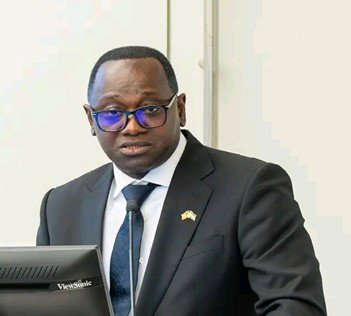
Finance Minister, Sheku F. Bangura
By Ishmail Saidu Kanu
The Government of Sierra Leone has expanded the implementation of Gender Responsive Budgeting (GRB) to ten Ministries, Departments and Agencies (MDAs) as part of efforts to promote gender equality in line with the Gender Equality and Women’s Empowerment (GEWE) Act, 2022 and the Medium-Term National Development Plan IV (NDPIV).
The GRB approach, which uses fiscal policy and public financial management to address gender inequalities, has been institutionalised following the passage of the GEWE Act 2022.
It requires all public agencies to prioritise gender considerations in budget planning, implementation, reporting and accountability during every budget cycle.
To enforce the Act in a phased manner, the Ministry of Finance (MoF), in collaboration with the Ministry of Gender and Children’s Affairs (MoGCA), issued Guidelines for Gender Responsive Budgeting to guide the preparation of the FY2026 budget.
The move began in FY2024 with five pilot institutions: the Ministry of Gender and Children’s Affairs, Ministry of Basic and Senior Secondary Education, Ministry of Health, Ministry of Defence, and the Sierra Leone Police.
For FY2026, five additional institutions have been incorporated, the Sierra Leone Correctional Services, Ministry of Agriculture and Food Security, National Commission for Social Action, Ministry of Tertiary and Higher Education, and the Ministry of Environment and Climate Change, bringing the total number of pilot MDAs to ten.
With technical support from the International Monetary Fund (IMF) through AFRITAC West 2, the Ministry of Finance coordinated the preparation of FY2026 Gender Budget Statements (GBS) for the ten pilot MDAs.
The process involved reviewing action plans and proposed budgets to identify key gender-responsive interventions, as well as assessing progress made by the initial five pilot MDAs in implementing their FY2025 gender budgets.
The Ministry noted that the pilot MDAs demonstrated readiness to adopt the GRB approach, as they had clear gender-focused policies, evidence-based gender data and indicators, and existing practices for mainstreaming gender in planning and budgeting processes.
Each of the ten MDAs was required to submit a Gender Budget Statement showing how their FY2026 budgets would address specific gender inequalities and the needs of women, men, girls and boys, including considerations for age and disability.
The consolidated FY2026 Gender Budget Statement shows priority areas such as gender mainstreaming in policy and budgeting, addressing sexual and gender-based violence, improving access to reproductive and child healthcare, increasing women’s participation in governance and security institutions, improving girls’ education outcomes, and expanding learning opportunities for persons with disabilities and school drop-outs.
The statement is expected to strengthen transparency, monitoring, and accountability in tracking the impact of public spending on reducing gender inequalities, while supporting inclusive growth and development under the NDPIV (2024–2030).